When the long-awaited road in Kurudu was finally completed, residents poured into the street with a sense of relief and quiet celebration. For drivers, it meant smoother movement; for traders, better access to customers; and for students and families, it promised safety, cleanliness, and progress.
Today, that promise lies buried under heaps of refuse.
Barely weeks after the road was constructed, scavengers turned sections of it into an open dump site. What was once a smooth stretch of asphalt is now flanked by piles of rotting waste, broken household items, and discarded materials, forcing road users to squeeze through a narrowing path and residents to endure the constant smell of decay.
For Umoru Ibrahim, a commercial driver who plies the route daily, the transformation has been painful to witness.
“We were all happy when this road was completed,” Ibrahim recalled. “It reduced traffic and made our work easier. But almost immediately, these boys they call scavengers—baba bola—started dumping refuse here. At first, it was minimal, so we thought it would stop. Instead, it kept growing.”
According to him, the scavengers often return at night to sort through the waste, looking for items they can reuse or resell.
“They come back in the evening to search for things,” he said. “As more of them joined, the dumping increased. Now the road is almost half blocked.”
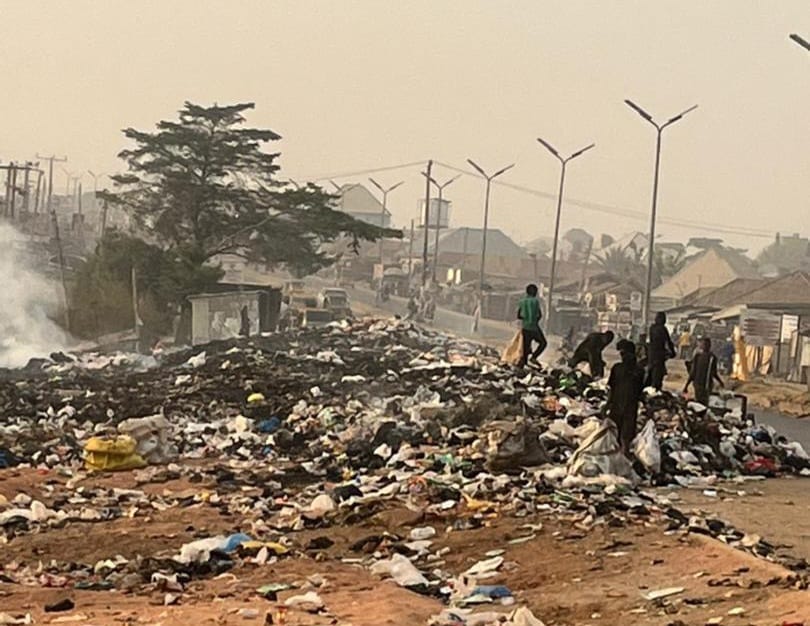
Just a few metres away from the dump site, Mama Blessing sits behind her small trading table, fanning away flies as she waits for customers who rarely stop anymore. The smell from the refuse, she said, has become a constant presence.
“This place smells terrible, especially in the afternoon,” she lamented. “Sometimes I feel dizzy. Customers complain and walk away. How do you sell food near something like this?”
She pointed at the road, now visibly narrowed by the expanding dump.
“Drivers struggle to pass here. Some scrape their vehicles; others shout and insult everyone around. But we are the ones suffering. This road was supposed to help us, not drive our customers away.”
For many drivers, the situation in Kurudu is part of a wider problem spreading across nearby communities. Adamu, who has driven commercial vehicles in the area for years, said roadside dump sites are becoming disturbingly common.
“This didn’t start like this,” he explained. “Before, you wouldn’t see dump sites everywhere. But now we have them in Nyanya-Karu, in Jikwoyi, and now here in Kurudu. It just keeps spreading.”
He warned that the refuse not only damages vehicles but also shortens the lifespan of the road itself.
“When water seeps into the road because of the waste, it damages the asphalt. Drivers suffer, and in a short time, the road will deteriorate again.”
Students who use the road daily also feel trapped by the situation. Joy Ekene, a student, described how temporary clean-up efforts have failed to solve the problem.
“Sometimes a truck comes and clears the waste,” she said. “We feel relieved for maybe two or three days. Then, gradually, the refuse spreads back onto the road.”
She shook her head in frustration.
“This road is still new. It’s painful to see it like this. This shouldn’t be happening at all.”
Beyond the environmental and health concerns, residents say the presence of scavengers has also raised safety concerns. Peter Augustine claimed that some of them use scavenging as a cover for criminal activities.
“Many of them move from house to house pretending to help people with trash,” he said. “But some steal items from homes. People are no longer comfortable.”
As night falls, the dump site becomes even more troubling. The smell intensifies, flies hover over the waste, and residents avoid the area as much as possible. What was once a symbol of development now represents neglect and poor waste management.
Residents are appealing to environmental authorities, the local government, and community leaders to act quickly. They are calling for proper waste disposal systems, stricter control of scavenging activities, and regular monitoring of the road.
“We don’t want to lose this road,” Ibrahim said quietly. “We just want to enjoy what was built for us.”
For the people of Kurudu, the road was meant to mark a step forward. Instead, it has become a daily reminder that development without maintenance and enforcement can quickly turn hope into hardship.